AFM & NSOM
>>MadPLL®
Additional Information
Brochure 
AFM Video Tutorial 
Laser Focus World Article
Related Products
QS-PLL®
MCL-NSOM
SPM-M Kit
SPM Accessories
Tuning Forks
Nano-HS Series
Nano-OP Series
Nano-H Series
SPM-MZ
SPM Accessories
Nano-SPM200
Nanopositioning Accessories
Nano-Drive®
Questions?
E-Mail Us |
  |
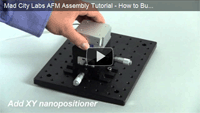
Instant AFM and nanoprobe instrumentation - just add science! View our AFM Video Tutorial. |
Introduction
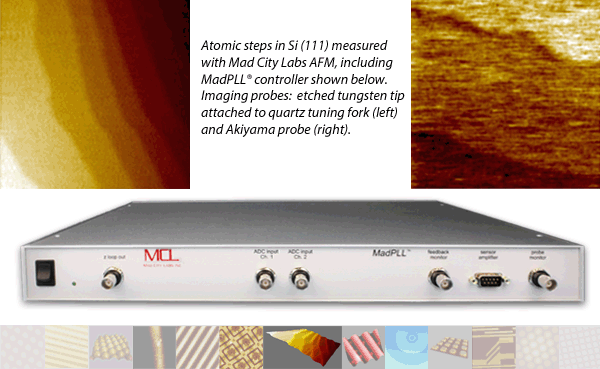
MadPLL ® is a powerful instrument package that allows the user to create an inexpensive, high resolution resonant scan probe microscope using Mad City Labs piezo nanopositioning systems. In short, MadPLL ® can be used to create an “instant” closed loop AFM or NSOM at a fraction of the cost of other commercial systems. Applications include the study of Nitrogen vacancies in diamond and optical antennae.
MadPLL ® has been specifically designed for resonant probes such as tuning forks and Akiyama probes. MadPLL ® is fully compatible with Mad City Labs’ high resolution piezo nanopositioning systems, giving users seamless integration of hardware and software with flexibility and performance not available in commercial scanning probe microscopes.
Features
- Low cost
- Software, sensor amplifier, and probe boards included
- 2 additional ADC connections for instrument versatility
- Low noise, atomic step resolution
|
- Automated software control
- Auto PCC control
- High resolution Auto Q calculation & resonant frequency detection
- Integrated Z axis PI loop
- Fully compatible with Mad City Labs positioning products
|
|
What is MadPLL®?
MadPLL ® is an integrated solution that includes the digital phase lock loop (PLL) controller, software, sensor amplifier, probe board mount, and resonant probe mounting board. Simply add your Akiyama probe or tuning fork to the probe board to create a powerful force sensor for scanning probe measurements with no optics required.
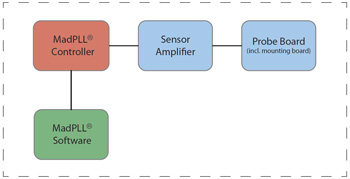 |
The MadPLL® package includes the MadPLL® digital PLL controller, sensor board, probe board, and MadPLL® software. Ease of integration with resonant probes and Mad City Labs' low noise piezo nanopositioning systems give users the ability to create high performance, low cost NSOM and AFM instruments. |
The PLL controller contains a digitally controlled proportional integral (PI) loop designed to work seamlessly with Mad City Labs’ piezo nanopositioning systems. The addition of closed loop piezo nanopositioners adds to the high performance of MadPLL ®. Additional options are available for multi-axis closed loop piezo nanopositioner control.
The PLL controller has three operational modes: self oscillation, PLL driven, and lock-in/DDS driven. The probe can be controlled in constant excitation or constant signal mode. Measured outputs from the controller include changes in frequency, amplitude or phase shift.
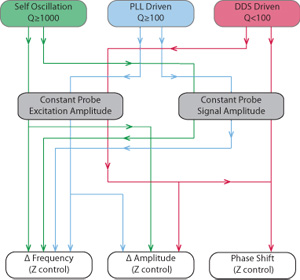 |
The digital MadPLL® controller has three operational modes: self oscillation, PLL driven, and DDS driven. The probe can be controlled in constant excitation amplitude or constant signal amplitude. Changes in frequency, amplitude, or phase are measured for Z control. |
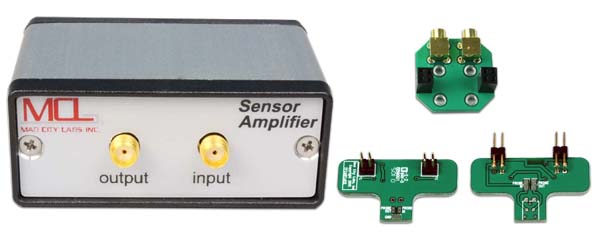
The sensor amplifier is the interface between the MadPLL ®
controller and the probe. The sensor amplifier contains a
preamplifier, an excitation signal attenuator, and a parasistic
capacitance compensation (PCC) circuit.
The probe board mount and probe board assemblies are compact and can be fitted to existing instrumentation. The probe board simply plugs into the probe board mount. The mount can be fixed to a precision positioner such as a closed loop piezo nanopositioning system. The probe board has been designed for use with tuning forks and Akiyama probes. These probes are easy to mount and alignment free.
|
MadPLL® includes a sensor amplifier, probe boards, and intermediate probe mount. The probe boards are designed for use with tuning forks, Akiyama probes and Accutune probes.
|
|
MadPLL® Software
MadPLL® software simplifies the control of your scanning probe microscope. All of the functions of MadPLL® are fully automated but accessible via individual software control. Among the software features are automated setup, configuration control, auto-Q calculation and automatic parasitic capacitance compensation (PCC) control. These included features are designed to simplify setup and accelerate the data acquisition process. MadPLL® software integrates seamlessly with Mad City Labs' AFMView™ software. AFMView™ software is part of our complete SPM development system.
|
Application - AFM Video Tutorial
Instant AFM - just add science!
MadPLL ® is the foundation of a customized, high resolution atomic force microscope (AFM) at a fraction of the cost of commercial systems. MadPLL ® seamless integration with Mad City Labs’ low noise single and multi-axis piezo nanopositioning systems makes it possible to create a fully closed loop AFM. The AFM described is suitable for both research and teaching environments and can be further customized for vacuum operation.
Video Bill of Materials
- SPM-M Kit
- MadPLL® Atomic Force Microscope Package
- digital phase lock loop (PLL) controller
- Akiyama probe mounting board
- sensor amplifier board
- Nano-SPM200 piezo nanopositioning stage (XY)
- Nano-OP30 piezo nanopositioning stage (Z)
- 3 axis closed loop Nano-Drive® controller
- Z axis open loop/close loop switch (OCL option)
- Adapter plate between preamplifier and Nano-OP30
- Adapter plate to Thorlabs MT1 micropositioner
- XY and Z coarse motion: standard stages available from optical component suppliers
- Probe: Akiyama probe
- Hardware: standard optical mounting fixtures
- PC: Windows XP/Vista/7/Windows 10(32 bit or 64 bit compatible)
This configuration is a highly flexible, low cost, multi-axis, closed loop Akiyama or tuning fork AFM called the SPM-M Kit. All Mad City Labs piezo nanopositioning systems have low noise PicoQ® sensor technology and closed loop feedback control. With MadPLL ® the user can create a high performance scanning probe instrument at reduced cost.
Additional options available from Mad City Labs
AFM configurations typically achieve Z resolutions of 0.5nm (rms) and a scanning frequency of 1Hz. Atomic step resolution and higher scan speeds can be achieved using da wide selection of Mad City Labs piezo nanopositioning systems designed for metrology and high resolution microscopy applications. All Mad City Labs piezo nanopositioning systems have low noise PicoQ® sensor technology and closed loop feedback control.
Recommended additional items
- Vibration isolation table
|
|
Image Gallery
Seeing is Believing!
The images below were acquired using MadPLL ® with Mad City Labs closed loop nanopositioning systems.
  |
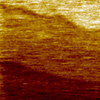
Si (111) Atomic Steps
(312pm monatomic layer thickness)
2µm x 2µm
Self oscillation mode,
constant probe signal
Z force feedback:
frequency
Data taken using MadPLL® with Nano-HS3 3-axis piezo nanopositioning system and etched tungsten tip on a quartz tuning fork. |
 |
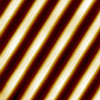
Si (111) Atomic Steps
(312pm monatomic layer thickness)
1.76µm x 2.02µm
Data taken using MadPLL® with Nano-HS3 3-axis piezo nanopositioning system and Akiyama probe.
|
 |
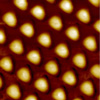
Calibration grid
(100nm tall lines, 2µm apart)
10µm x 10µm
Unidirectional scan
Self oscillation mode, constant probe signal
Z force feedback: frequency
Data taken using MadPLL® with Nano-HS3 3-axis piezo nanopositioning system and Akiyama probe.
|
 |
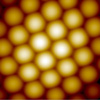
Calibration grid
(100nm tall pegs, spaced 2µm apart)
10µm x 10µm
Unidirectional scan
Self oscillation mode, constant probe signal
Z force feedback: frequency
Data taken using MadPLL® with Nano-HS3 3-axis piezo nanopositioning system and Akiyama probe. |
 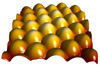 |
Fly eye
100µm x 100µm
Bidirectional scan
PLL mode, constant probe signal
Z force feedback: frequency
Data taken using MadPLL® with Nano-OP30 piezo nanopositioning system (Z-axis), Nano-OP100 nanopositioning system (XY axes) and Akiyama probe. |
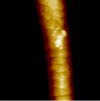 |
Human hair
100µm x 100µm
Bidirectional scan
Self oscillation mode, constant probe signal
Z force feedback: frequency
Data taken using MadPLL® with Nano-OP30 piezo nanopositioning system (Z-axis), Nano-OP100 nanopositioning system (XY axes)
and Akiyama probe. |
 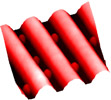 |
PMMA pattern, uncured
10 µm x 10 µm
Bidirectional scan
Self oscillation mode, constant probe signal
Z force feedback: frequency
Data taken using MadPLL® with Nano-OP30 piezo nanopositioning system (Z-axis), Nano-OP100 nanopositioning system (XY axes) and Akiyama probe.
|
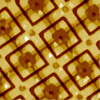 |
Integrated circuit
100 µm x 100 µm
Bidirectional scan
Self oscillation mode, constant probe signal
Z force feedback: frequency
Data taken using MadPLL® with Nano-OP30 piezo nanopositioning system (Z-axis), Nano-OP100 nanopositioning system (XY axes)
and Akiyama probe. |
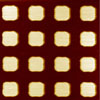 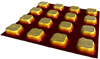 |
Calibration grid
40 µm x 40 µm
Unidirectional scan
Self oscillation mode, constant probe signal
Z force feedback: frequency
Data taken using MadPLL® with Nano-OP30 piezo nanopositioning system (Z-axis), Nano-OP100 nanopositioning system (XY axes)
and Akiyama probe. |
 |
Calibration grid
(100nm tall, 10µm pitch)
70 µm x 70 µm
Unidirectional scan
PLL mode, constant probe signal
Z force feedback: frequency
Data taken using MadPLL® with Nano-OP30 piezo nanopositioning system (Z-axis), Nano-OP100 nanopositioning system (XY axes)
and Akiyama probe.
|
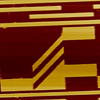 |
Etched structures
80 µm x 80 µm
Bidirectional scan
Self oscillation mode, constant probe signal
Z force feedback: frequency
Data taken using MadPLL® with Nano-OP30 piezo nanopositioning system (Z-axis), Nano-OP100 nanopositioning system (XY axes)
and Akiyama probe. |
|
Technical Specifications
Lock-In Amplifier |
| Phase Shifter |
0° to 360° |
| Demodulation Bandwidth |
3 kHz |
Phase Lock Loop |
| Auto Range Selection |
YES |
| Measurement Range |
± 500 Hz |
| Measurement Resolution |
50 mHz |
Preamplifier |
| Input Gain (Attenuator) |
0x to 1x (16 bit internal DAC) |
| Parasitic Capacitance Compensation (PCC) |
YES (16 bit internal DAC) |
| Automatic PCC |
YES |
Probe Oscillation Loop |
| Operating Modes |
self oscillation
PLL driven
lock-in/DDS driven |
| Amplitude Control Modes |
constant excitation
constant signal |
| DDS Resolution |
92mHz |
| Amplitude Setpoint |
16 bit internal DAC |
| Amplitude Control |
YES, adjustable PI loop filter |
| Input Voltage Range |
±10 V(peak) |
| Input Voltage Gain |
2x to 40x |
| Frequency Range |
10 kHz to 100 kHz |
| Output Voltage Range |
±10 V(peak) |
PI Loop Filter (Z-Axis) |
| Integration Time Constant |
digitally controlled |
| Digitally Set Parameters |
YES |
| Error Signal Inversion Capability |
YES |
| Sensor Signals |
frequency
phase
excitation amplitude
signal amplitude |
| Command Signal |
16 bit internal DAC |
| Automatic Loop Filter Setup |
Yes, after initialization |
| Loop Output |
0 to 14V |
General |
| Spectrum Analysis |
amplitude, phase |
| Feedback Monitor BNC |
frequency
phase
excitation amplitude
signal amplitude |
| ADC input (2 x BNC) |
0 to 10V input range, 16 bit |
| Probe Signal Monitor (BNC) |
sinewave amplitude probe (diagnostic) |
| Power Supply |
90 to 260 VAC (50/60 Hz) |
| Controller Dimensions |
16.75" x 14" x 1.75" (1U)
(42.55cm x 35.56cm x 4.45cm) |
| PC Connection |
USB |
| Operating System |
32 bit: Windows XP Pro/Vista/7/8
64 bit: Windows XP Pro/Vista/7/8 |
| LabVIEW Software OS |
32 bit: Windows XP Pro/Vista/7/8
64bit: Windows XP Pro/Vista/7/8 |
|
|


 Mad City Labs AFM Assembly Tutorial - How to Build an "Instant" Atomic Force Microscope
 Powered by Bioz