
PicoQ® Sensor Technology
Flexure Motion
Eliminating Coupled Motion
High Resolution Sensors
>>Nanopositioning Accuracy
Piezoactuator Information
Technical Papers
 High-Speed Precision for 3-D Images Long Range Motion with Nanometer Precision Piezoresistive Sensors Understanding Noise at the Nanometer Scale Nanopositioning Resolution
Additional Information
Measuring Atomic Steps
Sub-Nanometer Motion
Measuring Surface Roughness
High Resolution Sensors
Nanopositioning Accuracy
Questions?
  |
PicoQ® PrecisionMad City Labs closed loop nanopositioning systems are capable of providing picometer level positioning. Position noise, the lower limit on controllable motion, can be thought of as the true positioning resolution of a nanopositioning system. Position noise is the sum of all unwanted (but unavoidable) noise in the complete system.For further information, see our PicoQ® Sensor Technology page. Linearity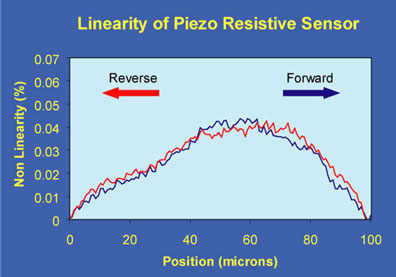 The accuracy and reproducibility of any piezoactuator driven nanopositioning stage depends primarily on the linearity and sensitivity of the stage. The linearity and sensitivity of a stage are different depending on the operation mode, open or closed loop.
 When operated in the open loop mode, the hysteresis and creep of the piezoactuator determine the non-linearity, which is typically 8% or more. This non-linearity is due to uncorrected hysteresis in the piezoactuator. Linearity is greatly improved when operating in closed loop mode. In closed loop operation, a control circuit compares the input signal to a signal from a position sensitive detector. The control circuit continuously adjusts the driver voltage to ensure that the input signal matches the position signal. The linearity of a nanopositioning stage, when operated in closed loop mode, depends on the linearity of the position sensor - not the piezoactuator. Mad City Labs nanopositioning stages use semiconductor piezoresistive networks for position sensing. These detectors have a linearity of better than 0.05%. The closed loop linearity of a Mad City Labs nanopositioning stage is shown above. The linearity matches that of the sensors and is better than 0.05%. |
Copyright © 2024